
|

 home
home
Gravity Awareness ExperimentsThe following three diagrams illustrate gravity experiments that should really be done in order. This first experiment is similar to the one that Henry Cavendish used, in 1798, to determine an accurate value for Isaac Newton's Universal Gravitational Constant, 'G'. 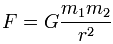
An excellent video and explanation can be seen at www.fourmilab.ch/gravitation/foobar/ You need to read the Fourmilab webpage to get a feel for what is going on. Experiment No1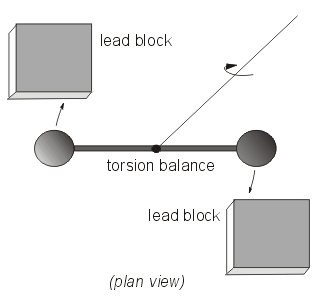
The diagram above shows the apparatus looking from above. Two ball shaped weights at the end of a solid bar are suspended in the middle by fishing twine. Two large lead weights are placed near to the balls and the corresponding gravitational attraction between the masses can be witnessed as the suspended balls start to rotate. Experiment No2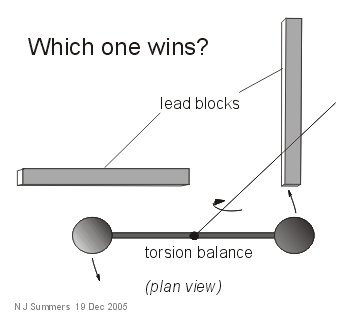
This experiment is used to determine that there are variations in the strength of the gravity field around a solid bar. The gravity field is stronger at the ends of the bar. The earth exhibits gravitational anomalies near mountain ranges and deep ocean trenches. For more information on this see www.csr.utexas.edu/grace/publications/fact_sheet/3.html Experiment No3
This experiment shown above demonstrates the possibility that the gravitational anomalies in the system contribute, if given an effective central pivot, to the suspended balls rotating (potentially) almost ad-infinitum. In this example, there is a null point which should be overcome by the systems inertia so you may have to give it a kick start. For an explanation of what is expected to happen you need to think of the large static lead rods as behaving like vacuum cleaners. The only difference to a vacuum cleaner is that they are sucking in a form of energy instead of air. It is the movement of this gravitational energy which imparts a force on the suspended weights. The effect is not too dissimilar to that predicted by Lense Thirring. Experiment No4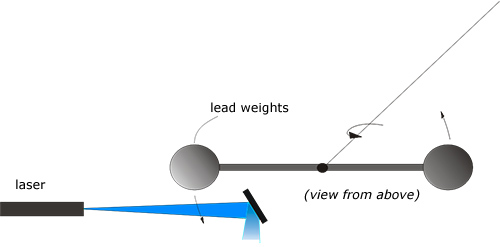
This experiment pioneered by Louis Rancourt at Boreal College, Ontario, demonstrates how electromagnetic radiation also warps space in much the same way as matter does. Below is an outline of the experiment which shows a laminar laser beam passing close to the weight on one side of a torsion balance. The weight on the opposite side is shielded. Experiments show that the weight moves towards the light. More research needs to be done but I believe the significance of this is far greater than the trivial description I have presented here. For more information see www.researchgate.net/profile/Louis-Rancourt Experiment No5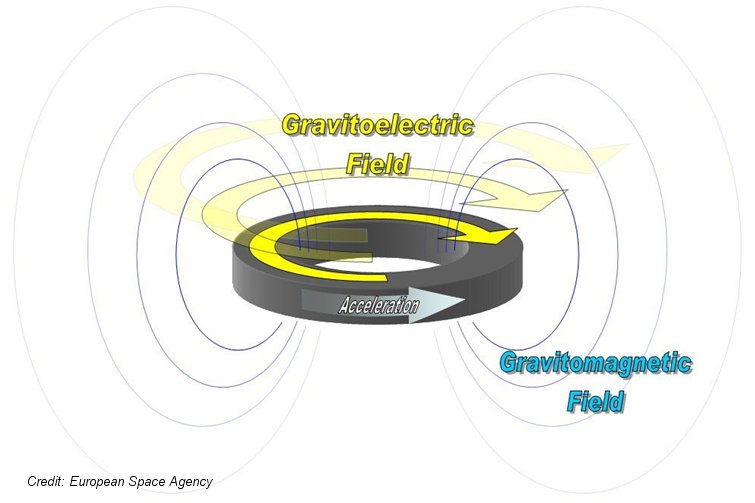
The experiment, shown above, demonstrates how a fast spinning superconducting magnet may show measurable closed loop gravitational anomalies, details of which can be seen at Experimental Detection of the Gravitomagnetic London Moment by austrian physicist Martin Tajmar Note that the gravitoelectric effect will predominanly occur during the accelerating phase of the ring. This effect was first observed by Dr Eugene Podkletnov at Tampere University, Finland. His recent experiments using high voltage pulsed discharge through a superconducting coil show similar momentary gravitational anomalies. For a report on the experiment in collaboration with Giovanni Modanese see http://arxiv.org/abs/physics/0209051. American physicist, William J Hooper (B.A., M.A., Ph. D. (University of California Berkeley) did extensive research until his death in February 1971 in what he described as "motional electric field" which he believed was closely linked to what causes the gravity effect. More information, background, filed patents etc. can be found at http://www.rexresearch.com/hooper/gibson.htm
Experiment No6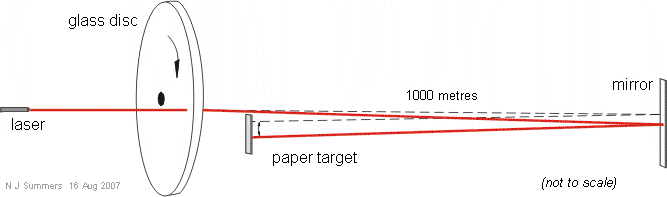
The proposed frame-dragging experiment, shown above, is to illustrate how moving matter can influence the local "space-time continuum". I am joking when I use that expression but it is not too far from the truth. I should more accurately say that moving matter has an effect on the 'motional' energy (gravitational field) that it is moving through. The logic behind this is that if gravity can have an effect on matter, matter can have an effect on gravity. The idea here is to pass a laser beam through the outside edge of a glass disc or cylinder that is able to rotate at speed. At a reasonably long distance away is a reflecting mirror which sends the beam back to a target in the vicinity of the disc. The position of the beam is noted when the disc is at rest and when it is rotating. The deflection will be consistent with the 'Fresnel drag coefficient' repeatedly established by experiments and notably confirmed by Fizeau in 1848 - see https://paradox-paradigm.nl/preface/the-experiment-of-fizeau/ The atomic particles which make up the glass disc partially drag the local energy field along with them as the disc rotates (frame-dragging), which in turn deflects the beam. Obviously, spinning a glass disc at high speed runs the risk of serious injury and shouldn't be
attempted without ensuring adequate safety precautions.
Limitless energy? - maybe ...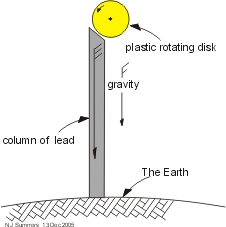 Now, I'm not sure about this one but it does provide food for thought. The sketch above shows a tall column of lead standing perfectly vertical and a disk free to rotate positioned on the top. The disk has its left hemisphere in an area of increased gravitational attraction due to the earth's gravity plus that gravity contributed by the mass of the lead column (if you have some doubt as to whether the top of the column will have more or less gravity then please look at data compiled by the https://earthobservatory.nasa.gov/features/GRACE/page3.php which shows increased gravitation over mountain ranges). The right-hand side of the disk is an area of slightly lower gravitational attraction. Think of it as a waterfall or mill wheel where there is more water passing over the left hand side of the disc than the right. This imbalance may cause the disk to rotate in the direction shown without breaking any laws of thermodymamics as gravitational energy is the power source in this case. This experiment requires the understanding that gravity is a metaphysical flow of dark energy. ---------------------------
|